
Planning the Future, III
An orthodox Marxist critique of 20th century socialist planning

I publish twice a month. On the first Saturday of every month, readers can expect a “mainline,” often multi-part essay clarifying, applying, or adding onto Marxist theory. Two weeks later, a “sideline” essay is published, usually analyzing a major current event or viral point of discourse. Every essay is free for one month after publication, after which it is automatically paywalled (with exceptions). For access to the entire archive, please consider a paid subscription.
Quick Recap

The prior entries in this series provided two very important clarifications/demystifications of liberal critique of monopoly:
Monopolies tend to become more efficient as they scale up, not less.
Monopolies tend to produce more significant innovations faster than the free market.
These are the clarifications of the following liberal critiques:
Monopolies are bureaucratic, inefficient, and more expensive to deal with.
Monopolies strangle innovation by crushing the competition.
While it is the case that the above critical myths can be considered true in some circumstances, the general trend is that industrial monopolies streamline, research, and reinvest because it is only once an industry is monopolized that it becomes rational to do so. However, it is also the case that the following is true:
Monopoly business models seek to extract rent from a captive consumer base.
Monopolies strangle in-house innovations which could disrupt existing revenue streams.
Post-2008 service sector monopolies are highly inefficient and do not provide the use-values of industrial monopolies.
Once-mighty industrial monopolies have been globalized and offshored, liquidating the American industrial workforce.
A monopoly’s primary motivation is to generate as much profit as possible, irrespective of the use-values it provides or the job security it could provide to labor.
All industry is indirectly coordinated by finance, and as such, there is a persistent pressure to liquidate in order to boost profits in the short-term rather than plan for the long-term.
The second entry to this series provided a Marxist critique of monopoly under capital’s logic. This is not a critique of monopoly as such for two, very concrete reasons:
Monopolization is inevitable in competitive markets where consolidation and economies of scale are more rational.
Attempts by the state to break up monopolies are more so politically or ideologically driven rather than strictly rooted in economic rationality.
Thus, it is my position—and generally the orthodox Marxist position—that monopolies both cannot and should not be dismantled. They cannot be because they will always arise again where the economy demands that they do, and they should not be because managing the scale and number of monopolies has nothing to do with their actual operation.
What this implies is that central planning of the economy is the future. In fact, it is already here in a highly stratified, siloed, inefficient form cobbled together by over a century of globalization, progressive reform, and vertical integration. This system we have inherited is running out of steam. Its core contradictions are coming to a head, manifesting in geopolitical turmoil, internal instability, and social atomization. Countries which used to be at the forefront of industry are now failing to reproduce their labor pools, and thus are failing to reproduce themselves.
What is needed, then, is a radical streamlining of our existing central planning project according to the logic of labor rather than that of capital. Of course, central planning has been attempted before. This entry in the series will examine how and why central planning has failed in the past and how those same failure modes are manifesting today under globalized capitalism.
Novus Homo Post Mortem

The old Soviet command-style system was the result of a permanent war economy in a country that was ill-equipped to handle the peer-to-peer warfare of the early to mid 20th century. Soviet ideology and modes of governance were shaped by these apocalyptic conditions. There was no shop-floor from which Bolshevik cadres could evangelize; it had to be built as soon as the revolution occurred. This project demanded population transfers, agricultural consolidation, mass proletarianization, and rigid bureaucratic hierarchies. Then came the pressures of a revolutionary society under siege: The early Soviet Union was rife with Western spies, ideological saboteurs, and unhappy pluralistic organs. Thus, order championed liberty by necessity.
The same was true in the postwar Eastern Bloc, with the caveat that these nations did not experience organic revolution as the Soviets did. That it was imposed on them from above meant that their economies had to have been organized in similar fashion. In China, where the revolution was more or less organic, conditions were even worse than those in Russia. They had a much larger peasant population, and a much older, more conservative, and less stable patchwork of feudal parcels—thus, peasants and the colonized became the subject of socialist revolution, rather than near-nonexistent Chinese proletariat.
Early on, these models proved successful in wartime, but adapted poorly for peacetime. Eventually, the founding contradictions of these systems would lead to their demise (although not for China, for reasons which will be explored below). For illustrative purposes, I will pair one country with a particular failure of central planning. Each of these issues existed in all of these countries, but some exemplified them better than others.
The USSR & Sclerosis
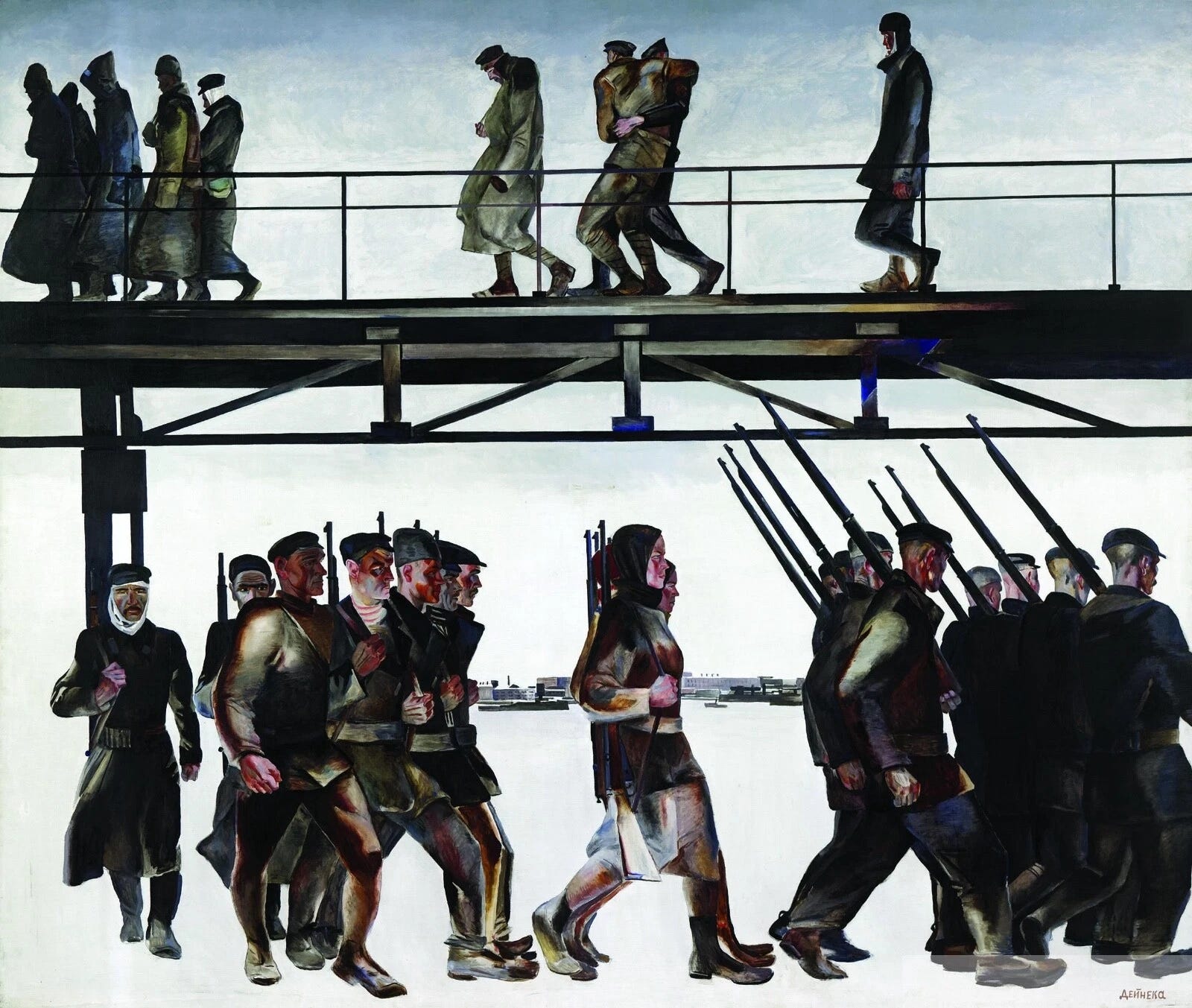
The USSR was exceptional at producing vast quantities of hard goods. What it was terrible at was adaptation and innovation. Once an industrial sector became politically represented, it became almost impossible to kill when it became obsolete. Moreover, while there were incredible innovations in aerospace and telecommunications, these innovations remained institutionally insulated and did not diffuse out to the rest of society. These facts stemmed from three mutually constraining and contradictory impulses in Soviet society: The pragmatic need for rapid heavy industrialization, the ideological need for politics to be guided by the needs of industry, and the security need to keep their innovations hidden from the West.
Despite being “top-down,” many obsolete industries (coal, pre-CNC machining, pig iron) could not be dismantled by penstroke because doing so meant dismantling an entire region’s economy. Their work could not even be interrupted for refitting and retooling, as doing so would mean deviation from the Gosplan. Planners worked around surviving the logic of the Gosplan, not around actual economic rationality. A temporary shutdown of six months meant output would be halved for the year and funding, resources, and political considerations would be cut for that region or sector—even if the next year’s output doubled that of previous years, and even if the output quality was far better than before. The plan only really accounted for quantity, a legitimacy metric inherited from its wartime origins.
Employment was the Soviet welfare system, as well as the bedrock of political legitimacy. The outputs of heavy industrial towns propped up other sectors as well: schooling, medicine, entertainment, grooming, retail, and so on. Full employment was not optional, even when there was no need for local labor. There was simply no legitimate way to access basic resources outside of working in a state-backed firm even when the state failed to provide and the black market filled in the gaps. Moreover, obsolete regional industries had ample political sway to protect their existence and inclusion in the Gosplan. Members of the Politburo and other high offices emerged from their cadres; they were not a forgettable, atomized constituency in the Appalachian hinterlands.
Workers in these sectors did want to improve workplace efficiency, get new machinery, work in newer, shallower mines, but there were no mechanisms or incentive structures to allow for this in the civilian labor pool. Even if there were, improved productivity is usually followed by a labor glut—surplus labor. If every industry saw consistent productivity gains, the political problem this surplus poses would compound into an existential crisis for the Soviet Union. What do you do with laborers you don’t need? This question was incompatible with the logic of Gosplan and led to “labor hoarding,” i.e., keeping functionally unemployed people on the payroll to eke out a boost in productivity when needed instead of reinvesting in new machinery.
One sector avoided this surplus labor trap: The military-industrial complex. The aerospace, nuclear, and heavy weapons industries gained their legitimacy not from job security or sheer quantity but from more qualitative metrics which maintained parity with the United States armed forces. It is for this reason that the Soviets were able to put a man in space while peasants continued to use horse-drawn carts as their primary mode of transportation.
The Soviet MIC was designed to absorb downtime, allow for retooling, and did not have the same political or fiscal incentives as the civilian industries. It was favored in nearly all respects, and often absorbed overproduction in the civilian industries since those factories were dual-use. Unlike the American MIC, however, any major technological advances which could have been repurposed for civilian use were either kept secret or could not be manufactured at scale by regional ministries. Where Space Age materials in the US became mattress material and microwave ovens, the Soviet equivalents never trickled down. This further restrained the Soviet economy by making its lower productivity obvious, and heightened public perception that capitalist economies were lapping them because in many respects, they were.
These are the structural conditions that Gorbachev inherited when he began his liberalizing reforms. Rather than providing more in the way of consumer choice or breaking the stagnation of the 1970s, these reforms accelerated the disintegration of the Soviet Union. Glasnost laid bare all of the hidden corruption occurring within the system, destroying its legitimacy. Perestroika was both too rapid in dismantling plan authority and not radical enough in creating a new coordinative logic, creating economic vacuums which only black markets could fill. Taken together, they damaged legitimacy and coordination before an alternative set of institutions could emerge to absorb the fallout. By 1987, many planners with access to foreign hard currency and export markets began leveraging their positions and preparing exit funds. Their roles were already in the process of dissolving; by 1991, these offshore accounts became a source of personal enrichment for nomenklatura who would later become oligarchs. Gorbachev could not address the USSR’s core contradictions, and the path he took to ameliorate them irreparably damaged the Union in unexpected ways.
Romania & Larceny

Romania was obviously much smaller than the Soviet Union, and thus commanded a smaller reserve army of labor, fewer natural resources (though it punched above its weight in oil production), and was not as industrialized as its neighbor to the east. The Romanian economy was structured very similarly to the Soviet Union, so much so that discussing the differences in planning would be splitting hairs, with one major exception: The decision of Romania’s leadership to pursue autarkic policies while rapidly repaying the state’s foreign debts.
That decision, though rational for a regime seeking total sovereignty from both the West and East, resulted in Romania becoming one of the most economically backwards countries in the Eastern Bloc, and as a result of this desperation, one of the most politically repressive.
Romania did not have the foreign currency to repay its debts, so it sold off whatever surplus it could in the form of oil, machine parts, and consumer goods for Western markets. The labor force was put to work producing goods almost exclusively for export, leaving behind very little for reinvestment or even basic maintenance. By the 1980s, all goods were rationed; salaries remained reasonable, work was both mandatory and guaranteed, and quality of life was affordable on paper, but there were chronic shortages of food, electricity, even glass bottles. Like in the USSR, black markets emerged to fill in the gaps that central planning could not address, but unlike the USSR, the black market eventually overtook the formal economy and became the primary means of survival for many Romanians.
There were two primary vectors for these illegal markets: Laborers committing petty larceny over time, and merchant mariners smuggling in foreign goods and capital. These supplies would be brought together in informal shops run out of people’s apartments. The state butcher shop would be empty, but the butcher’s apartment would be well-stocked—and far more expensive than permitted. The security services often participated in this economy rather than shutting it down because they survived off of bribery and protection rackets. The formal economy was a complete fiction and virtually everyone knew it. The state, however, expected that once its debts were fully repaid, it could reallocate labor toward domestic projects once again—without recognizing that the planned economy had already failed as an allocation system.
It is for this reason that the state collapsed rapidly and the country descended into urban warfare in 1989, the only Warsaw Pact nation to do so. The Romanian state began to cleave; some factions remained loyal to the Ceaușescu clan while others sought to overthrow it. The loyalists were emboldened by the fact that foreign debts had nearly been paid off, insulating them from external leverage that might have otherwise forced them to step down. The public was emboldened by the rumors of rebellion elsewhere, and thus began to express their dissatisfaction en masse for the first time. Meanwhile, the opportunist factions were emboldened by the military’s decision to break with the regime, and used the ensuing chaos as cover for a successful coup d'état. But unlike in Poland or East Germany, there was no political alternative; society was fractured and atomized by the parallel economy and pervasive state surveillance. Thus, the violence was swift, brutal, occurred largely between capable state actors, and ended as rapidly as it had begun.
Romania is highlighted here because it provides a useful case study in four related dynamics:
How black markets emerge as survival mechanisms when central planning is no longer organized around the reproduction of labor
How reliance on informal economies erodes state legitimacy by creating parallel systems of allocation
How the aggressive pursuit of sovereignty can become self-defeating when external independence is achieved at the expense of domestic reproduction
How the lack of political alternatives organized by laborers created a liberal state de facto run by the security services of a disgraced communist party
China & Clientelism
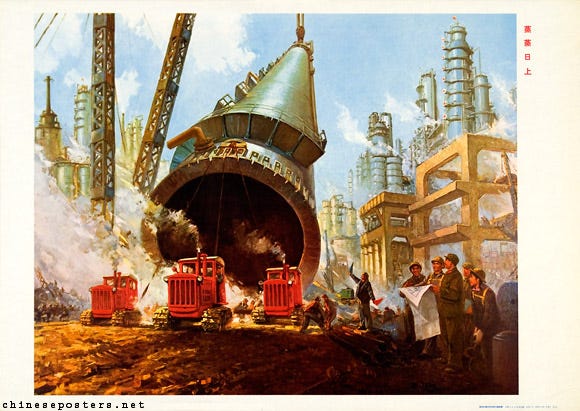
China has not failed (yet) to manage its internal contradictions. On the contrary, its leadership has done exceptionally well relative to prior case studies despite originating from an even more apocalyptic set of conditions. However, the CCP’s system is not without its own degenerating contradictions, and within our lifetimes, it will have to come to terms with them.
Chinese central planning is a more stable, guarded version of what perestroika was intended to offer. State-owned enterprises (SOEs) coordinate to supply the raw materials needed to sustain market activity in the Special Economic Zones (SEZs), the surplus of which is directed towards delineated national goals. This is, of course, an oversimplification. Allow me to introduce some needed non-exhaustive complexity:
The Politburo announces directives as broad political-economic priorities.
The National Development and Reform Commission (NDRC) and other relevant ministries develop a series of more detailed Five-Year Plans oriented towards meeting these broad priorities.
Provincial and municipal committees receive these directives, incentives, and failure conditions and mobilize their regions to meet the plan’s goals. In the process, they bargain with the NDRC and the central bank for funding, favorable legal designations, and infrastructure priority they claim will be needed to meet those directives. This mostly occurs through informal political connections and horse-trading.
SOEs are coordinated by local leaders to build up infrastructure to attract private actors making consumer goods. Local Party leaders create Local Government Funding Vehicles (LGFVs), using state-owned land as collateral to gain additional financing. They then negotiate with private actors to attract them to their municipalities—tax shelters, low utility rates, loosened regulations, robust services, etc.
Private firms (under the close guidance/mediation of the Party) then set up shop to manufacture according to regional or global market logic.
This is roughly how the system works. In many instances, however, private actors simply don’t appear. Infrastructure gets built, the province meets its goals (GDP growth, square meters built, etc.), and then all investment and construction stops until the next directives are passed down. The labor force present in the region is then liquidated and redirected to another province at an earlier point in the cycle. The provincial leadership is then rewarded for meeting its goals while obscuring potential scandals, or is harshly punished, depending on how successful the plan’s functionaries were at meeting its overall goals.
Occasionally, the punishment is retroactive. If, for instance, a Five-Year Plan demanded the construction of a shoe factory in a given municipality, and the local government created the shell of a factory with no actual operations, then this still counts as completion of the plan. However, if in the next Five-Year Plan, they are required to produce a given number of shoes for domestic consumption (their construction of a shoe factory being public record), they will scramble to fill the city with unskilled labor, housed in apartments of dubious quality, using equipment of unknown provenance, inside a factory that was never actually meant for its intended purpose. Failure to do so on time leads to reduced budgets, tighter financing, and fewer viable political connections to leverage in the future.
The above example is only the worst-case though; in the best case, it produces unparalleled manufacturing powerhouses on the order of the Pearl River Delta. Shenzhen, for instance, is not a ghost town whatsoever. Though built rapidly and according to the same incentives structure as the “tofu dregs” and “nail houses,” it is a modern global city and a hub for some of the best computer components and engineering talent in the world. In some cases, the scramble to meet quota has generated real investment and lasting prosperity. The ghost-city phenomenon is, at this time, only regionally pathological, not wholly systemic.
What is systemic, however, is that all of this is subordinate to globalized capital. China’s economy would collapse overnight if it were to be insulated from worldwide trade because the system is organized according to global demand, not local. While it has reoriented some of its demand locally, and while it has begun to adopt more qualitative metrics than “GDP must go up,” China is still largely at the whims of the rest of the world. They produce so much that they simply cannot absorb their own overproduction. Most of the Politburo’s directives are not geared towards developing China for its own sake, but towards geopolitics and their own market leverage within the global capitalist system. This is not an oversight or a strategic error; it was the logic which enriched China while the Soviets self-immolated.
Despite all the benefits, this is still evidence of a core dialectical tension within China: The state does not prioritize the needs of its internal population of laborers. Increasingly, it exists to be the world’s factory, and has long-term aims to supplant the United States as the guarantor of global trade and finance. This is where the origins of modern Chinese planning begin to meet a wall.
Should the renminbi become a serious candidate to replace the US dollar as the world’s reserve currency, China would need to deindustrialize over an extended period just as the United States did when it took on this charge. Global reserve status does not mechanistically require deindustrialization, but it does create political duties which disincentivize domestic production in favor of global financial intermediation. Moreover, China’s financial sector is no more stable than that of the US; in fact, in some ways, it’s worse. Many of the metrics that Chinese financial firms rely on to generate their fictitious capital are themselves completely fictional. Contrast this with the US during its deindustrialization period, where financialization itself—not state-derived quotas—masked our industrial decline. While the CCP has been cracking down on these distortions, they still occur by the nature of its procurement system, and there are no reforms on the horizon which can directly resolve this contradiction.
In other words, the very same systemic pathologies which led the United States to destroy its industrial infrastructure are emerging within China, because neither the US nor China are insulated, near-autarkic nations, as much as China likes to pretend otherwise. They are central to, and thus dependent on, the functioning of the global economy as it exists. They cannot reorient away from their roles without radical and potentially violent disruption.
China’s gamble that it could entrench itself in the global market for its own benefit did pay off and was necessary to a significant extent, but this contradiction is more likely to end China’s nominally socialist orientation than to end its experiments with capitalism. At no point does labor’s logic—that industry should be directed toward human development and evaluated through use-value—make its presence known. Thus, central planning in China will not fail as its predecessors did. It will likely continue on into the Chinese Century but will fail to achieve Marxist ends.
A Stillborn Future

Advanced Western countries which were at one point considered “high-trust” or “meritocratic” now increasingly resemble the failure modes of these prior experiments in socialism.1 Younger generations increasingly feel, rationally, that there is no point to their labor as they will never keep pace with asset inflation. New family creation is lower than at times of total war in recent history. While there is no shortage of food or consumer goods, there is increasingly a shortage of stable, well-paid jobs which can reliably cover basic necessities. Even “luxury” products are of poor quality relative to what they were once known for; they have instead become status symbols. Overlaid atop all of these economic and biopolitical trends is rampant ideological pollution, deeply internalized self-monitoring, and a nihilistic fatalism so pervasive it would make Dostoyevsky put a gun in his mouth.
A key symptom of this degeneration is that the public services sectors which once buoyed the working class now rely on rent-seeking extraction as well. Healthcare now operates on a dual-track wherein the lumpenproletariat use emergency rooms as primary care while mandated insurance premiums skyrocket. Education has all but abandoned the science of pedagogy and technical training in favor of grade inflation and opportunistic credentialism, all but guaranteeing exorbitant student loan approvals. Even law enforcement no longer has a legal mandate to protect individuals from harm, but to enforce the law more generally; in the meantime, qualified immunity for their actions has expanded dramatically.2 Deprived of productive labor as their organizing principle, these services will continue to be dismantled outright or be rendered inaccessible to the public they were once meant to serve. Without the ability to labor, the public ceases to exist as a subject of political economy, becoming instead the detritus of a failed state.
And then there is the problem of infrastructure, especially in the United States. The cost to build new transportation networks, factories, housing, even public toilets here is astronomical even by Western standards. Virtually everything is delayed or cancelled before completion, and what does get built is of exceedingly poor quality or utterly nonsensical. Projects are increasingly built to reallocate taxpayer funds towards consultants, NGOs, labor unions, and public agencies. In many cases, however, they provide little to no benefit to the public, and there is no real consequence for it. Almost everyone recognizes the astronomical waste, and yet such projects are still paraded around as massive victories. It already reads as Soviet satire.
After Build Back Better failed in the Senate, a series of other spending bills were passed to replace it: The American Rescue Plan, the Infrastructure Investment and Jobs Act, and the Inflation Reduction Act. In total, these bills generated nearly $3 trillion in new spending by the federal government. And what is there to show for it? Virtually nothing.3 Much of the spending went to propping up asset inflation and contractor rents, backfill for local governments nearing insolvency with zero restructuring requirements, and industrial policy driven by tax credits, along with several hundred billions of dollars dedicated to “green” projects which never materialized. Three trillion spent and hardly anyone noticed, save for the stimulus checks. Covid or not, this is where we are.
There is no future on offer, not even a feverish fantasy. The only thing this system can still produce is ever more abstract methods of mass suicide. Though it has living functionaries who will defend it to our deaths, they are not meaningfully in charge of it. They may be cruel, vengeful, contemptuous, but the system itself is not. It is exceedingly impersonal. Even actions which are actively motivated by a profound personal hatred are, in reality, the impersonal convulsions of a social system choking to death on its own feces, long incapable of birthing live young.
So then: what is to be done?
I don’t know. I’ll get back to you in another month.
The right-wing response to this transformation is often to blame mass immigration for much of this. I agree, with an important caveat. Mass immigration was adopted as both a technocratic solution to increasingly expensive and regulated domestic labor pools, and as an ideological cudgel through which the working class could be disciplined. The root, however, remains economic. Without addressing the structural inability of modern capitalist nations to reproduce their own labor forces, import of foreign labor will remain the standing order regardless of political rhetoric. The market produced no solutions to the problem of reproducibility, thus market planners adopted mass immigration; only central planning can resolve it.
There are exceptions to this pattern but they support my broad thesis. The prosecutions of Derek Chauvin and Darren Wilson, for instance, were ideologically exceptional. They did not materially alter the broader doctrines that insulate law enforcement from criminal liability. While police powers have expanded, the judiciary retains the capacity to selectively curtail or enforce these powers when it is politically expedient to do so. This discretionary nullification further erodes the legitimacy of the rule of law by revealing it as contingent rather than universal.
Yes, critic, I know that a chip fab set up shop near your Arizona summer home, but the scale of the spending and the grandiosity of the rhetoric surrounding these bills demand more than what was actually done. They spent the entire GDP of France on kickbacks to contractors who fixed a few bridges and hooked up a few new powerlines, they didn’t completely reorient the fundamental relationship between capital, labor, and the state. Neither did tariffs. Spare me the details next time and look at the bigger picture.
Lol footnote 3; 🤣
Look dig into working in and solving one of these sectors and then perhaps allow theory to be influenced by reality.
But at least you’re consistent; it must be central planning.
Very well how does one resolve the real contradiction of America being a Federation?
“core dialectical tension within China: The state does not prioritize the needs of its internal population of laborers.”
One could think that since this keeps happening perhaps it’s inevitable when the state contacts labor, one could also observe that Communism replacing Capital made Communists the new Capital.
Animal Farm certainly taught this as allegory.