
Contra Iran
What to "do" about a war we've all been waiting for

I publish twice a month. On the first Saturday of every month, readers can expect a “mainline,” often multi-part essay clarifying, applying, or adding onto Marxist theory. Two weeks later, a “sideline” essay is published, usually analyzing a major current event or viral point of discourse. Every essay is free for one month after publication, after which it is automatically paywalled (with exceptions). For access to the entire archive, please consider a paid subscription.
In Media Res
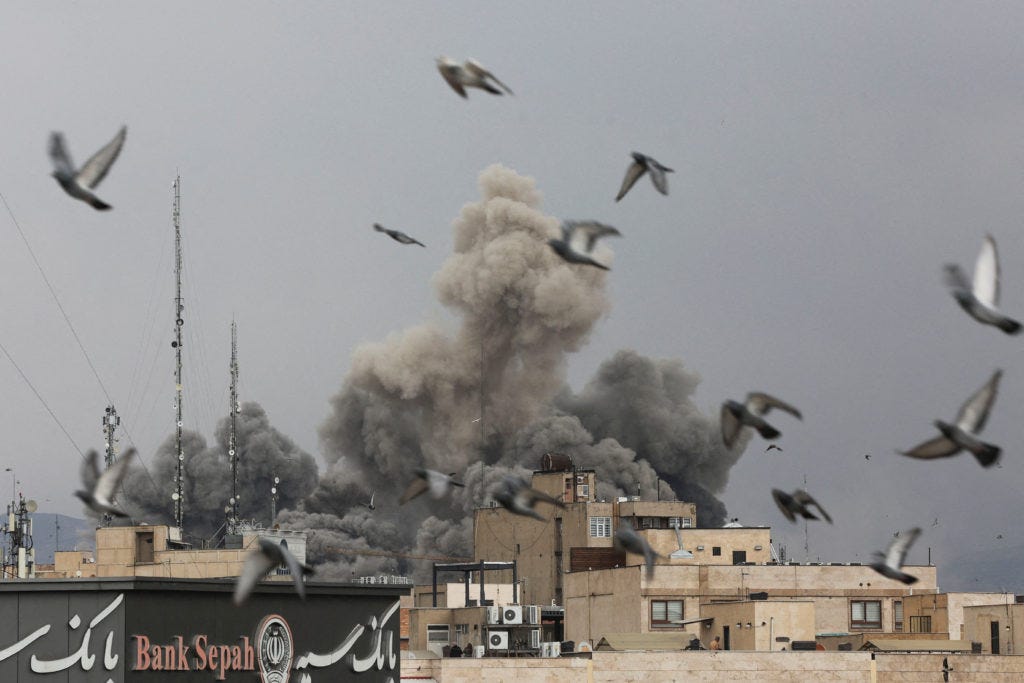
I confess that despite the military buildup in prior days, I was reciting “nothing ever happens” to myself. I believed the buildup to be an aggressive negotiation tactic rather than preparation for an actual conflict. I did think the US was going to attack Iran later on in Trump’s term, but I expected there to be a bullshit casus belli before then; the lack of one took me by surprise.
As of the time of writing (March 5th, 2026), these have been the major beats of the new conflict so far:
Feb. 28th - The US and Israel launch a joint strike against Iran targeting leadership, nuclear facilities, and military targets. A school building adjacent to an Iranian Revolutionary Guard Corps (IRGC) was hit, killing over 150 people, including children. It is unclear who launched it and whether this was deliberate or not. The Strait of Hormuz is effectively closed due to Iranian warnings to shipping vessels.
March 1st - Iranian media announces the death of Ayatollah Khamenei. Hezbollah strikes northern Israel in retaliation.
March 2nd - Iran launches retaliatory strikes across the Gulf region, targeting US bases and tourism hotspots. Iraqi Kurdish Peshmerga forces (with US support) invade northern Iran. The State Department urges evacuation of all expats living in the region; instructions have been muddled. The UK government urges shelter-in-place. Israel launches strikes on Beirut and renews its halted 2024 ground invasion into Lebanon.
March 3rd - Turkey shoots down an Iranian missile heading for its airspace. No retaliation from Turkey or NATO. A US submarine sinks an Iranian warship returning from an Indian military exercise off the coast of Sri Lanka.
March 4th - US Senate strikes down a resolution requiring Trump to seek congressional approval for further action. Israeli Defense Minister discloses he had originally planned to strike Iran later this year (in line with my own predictions).
March 5th - Iranian death toll at least 1200. Over 2000 targets in Iran have been hit. Trump predicts the conflict could last another four weeks, but the Pentagon is preparing for it to last until September. The Strait of Hormuz is still effectively closed.
Also of note is the consistent messaging on naval warfare: each update by the Trump administration has made it seem as though Iran’s navy is on the verge of complete destruction when this is not exactly the case.
The outbreak of this “special military operation” promises to be one of the more significant developments of Trump 2, and of the 2020s. This essay examines why, and more importantly, what a rational actor with no present leverage should “do something about it.”
The Grand Strategy
Each party to the conflict has competing goals, motivations for those goals, and strategies for achieving them. First, we examine the American bloc.
Israel
Regime change to accelerate the liquidation of Hamas and Hezbollah.
Become the only meaningful regional power.
Prevention of internal fracturing along secular/religious and Mizrahi/Ashkenazi lines.
Creation of a “Greater Israel,” full annexation of Palestinian territories and parts of Syria, Jordan, Egypt, and Lebanon.1
United States
Maintain (appearance of) global hegemony amid geopolitical threats from Russia/China.
Regime change to open the Iranian market.
Test state-to-state wartime capabilities, locate holes in logistics chains.
Maintain “special relationship” with Israel; military intelligence intertwined with Israelis, AIPAC/other lobbying firms to keep elections solvent, allow for persistence of a “global state” in the middle of the world.2
Trump administration (via Kushners) deeply entrenched in Israeli and Gulf State interests; probably owe favors, which I suppose have been cashed in. This is the only contingent interest and it might explain why this war is happening right now rather than earlier in Iran’s modern history.
Gulf States3
Return stability to the region to keep oil, tourism, and development capital flowing.
Reducing Iran’s external power projection without toppling the regime and opening a massive new power vacuum.
Maintain positive relations with the US and Israel to ensure position in global markets.
One can see the contradictions within this coalition quite clearly. The Gulf States need stability in order for their economies and political systems to remain viable. Therefore, they are aligned with Israel and the US on liquidating the Houthi and Hezbollah networks. They are not, however, aligned with regime change within Iran, as this has potential to destroy regional stability. They are then stuck within a rock and a hard place: accept the existence of a sovereign Iran capable of interfering in Arab politics, or accept the existence of an expansionist Israel, fully backed by the United States, dominating their multipolar node. For now, they have chosen the latter; this may not last indefinitely.
There is also a contradiction within the goals of the United States. While on the one hand, the US must maintain its position as guarantor of global trade—or, at minimum, its appearance thereof—its lack of a legible justification for this war challenges that position. The US and Israel instigated this conflict on their own. As a result, key energy shipping routes are closed. The attack on the Iranian ship in international waters far outside of Iranian territory means otherwise neutral areas of the ocean are now a war-zone too.
Moreover, full American support of Israeli regional ambitions leads the rest of the world to question whose interests the US actually serves. This abrupt war doesn’t even appear to be in the interests of the American state, much less its people. The support of one ally’s expansionist aims at the cost of other allies is incompatible with the American imperial project. That project requires a degree of actual, not just superficial, neutrality and this war breaches that.
But I am not naive. To the victor go the spoils. If the US is able to 1) usher in quick regime change, 2) without creating a power vacuum, and 3) while balancing the interests of its regional allies, then they will be able to retroactively create legal justifications and novel legal concepts for similar incursions in the future. It has done so before with the Monroe, Truman, and Bush Doctrines.4 That this war currently has no justification or legal precedent doesn’t matter today. It only matters for the future, which is a dangerous principle to act upon when the three conditions for success are not equally likely to occur.
We now move on to the opposing parties:
Iran
Maintain regime stability and continuity of governance.
Maintain regional power projection.
Curtail Israeli expansionist efforts.
Even if unsuccessful in the former three goals, deal severe blows to US legitimacy and military supremacy.
Hamas
Degrade Israeli military industrial capacity.
Force Israel to accelerate expansion before it is prepared to do so.
Weaken Israeli international standing.
Force Arab allies of Israel to question their coalitional allegiances.
Russia
Maintain internal sovereignty.
Stop the expansion of NATO.
Encourage Europe to drift away from the United States.
Contest the US’s power projection in its periphery (Africa, Middle East).
China
Maintain good relations with American allies and enemies alike.
Weaken US power projection.
Prepare to replace the US as guarantor of global trade.
I’ve included Hamas despite being orders of magnitude less significant than the other actors mentioned only because the present confrontation with Iran likely would not have begun if not for October 7th. The attack forced Israel into a position it was not prepared to be in. The Israelis likely knew they were unprepared to open new fronts, but given that the years since 2014 were marked by serious internal division and unrest, they couldn’t help but accept the opening of this front to serve as a new set of unifying conditions. The gamble Hamas leadership took was that they might be destroyed swiftly, but the Palestinian national project might outlive them if Israel burned through enough regional goodwill quickly. Going the route of the Palestinian Authority and seeking a two-state solution promised only the slow, grinding dissolution of this project. Thus, even though Hamas has been all but obliterated, Israel’s war against them is far from over.
The contrast with the prior list of coalitional interests is apparent. There do not presently exist severe structural contradictions in this arrangement, nor are there strong reasons for Russia and China to support Iran to the same degree the United States supports Israel. They can take a backseat to the action and wait the situation out. The conditions for mutual success are broader, less specific, and easier to achieve than those of the United States, Israel, and the Gulf States. There are fewer wildcards to concern themselves with, and—crucially—Iran’s defeat would not be the end of the loose coalition’s project. An extended American quagmire in Iran could very well create the conditions for success.
And yet, even if the US wins outright and every condition for success is met, this still does not mean defeat for the coalition even if it does mean the end of the Islamic Republic. It would be a setback, a lost battle within the context of broader geopolitical conflict, but it would also be instructive. It would answer the following questions, key to keeping pressure on the United States:
What shape would Iran take after the conflict is over?
Just how strong are NATO and Gulf State commitments to the US and Israel, and how will the contradictions within these alliances be managed or resolved?
Is the United States capable of rapidly replacing lost materiel, and if so, how will it do this, and how rapidly?
To what degree can the United States reshore its military and civilian supply chains, and how would it do so?
Most importantly: How effective is the United States military at fighting an asymmetric war against a sovereign state in 2026? Everyone is preparing for a future conflict in which these two blocs are fully activated. The US is the lynchpin for its coalition; military, industrial, nuclear, and financial strength are far more decentralized among the opposition, though China is the obvious dominant player. Today, the US is involved in regional wars; tomorrow, war will be global.
Though there still exist contradictions between the members of this oppositional bloc, they aren’t especially relevant to this conflict. They will only become structural once institutions replacing the American-led world order are built. The greater threats are the internal contradictions of each member nation, as these are what currently prevent Russia or China from making a play for the throne in the immediate future. Russia must figure out how to contain and integrate eastern Ukraine before it commits to a broader theater of war. China must deal with its financial woes and secure stronger military alliances. Both must select successors to their current long-time leaders, as both Putin and Xi would be too old and feeble to preside over a total war. Iran must not only survive, but come out of the present conflict stronger than it was before if it is to remain an active player; still, its inclusion as a sovereign state actor is not strictly necessary. While the US-led coalition is showing severe cracks in its pottery, the China-led “coalition” is still wet clay. The latter cannot afford to bake itself into something more solid, so it defers this process either until it can do so with substantially less risk or it is forced into doing so by strategic necessity. It is a gamble to wait, but then, so is starting a war.
We have one more actor to mention5 whose inclusion in either camp creates unique strengths and weaknesses entirely contingent on which direction they decide to go in: Turkey.6
The Turkish Republic is a wildcard. It is not itself chaotic or unpredictable. It is both legible and relatively stable. The world around it, however, is not. Turkey and Israel are at odds over who should be the regional power over the Middle East. It is not unreasonable that if Iran is taken out of the picture (or even before), Israel will begin making moves to subvert Turkish power projection. Turkey is a NATO state; Israel is not. Thus, if Israel were to one day strike Turkey, the US and Europe would be forced to take a side, neither of which would be good for American imperial legitimacy.
Russia controls the Black Sea. Turkey controls Russian access to the Mediterranean via the Dardanelles Strait. It is mutually beneficial for each to have a good relationship, even if Russia is technically frozen out of the European market. But Turkey is in NATO. Most NATO countries support Ukraine. This should pit the two against each other, but it doesn’t, because Turkey doesn’t want to deal with the fallout. The US may pressure Turkey to close the Strait, as it has tried to do in the past. But Turkey hosts American nuclear weapons; they might decide it’s not worth hosting them if Russia can offer a better deal. That’s a risky gamble, but not one without leverage.
Turkey, Russia Israel, and the US were all heavily involved in Syria. Turkey actively occupies parts of northern Syria. Russia has called for them out and Turkey has refused; it’s put a strain on their relationship, but with Russia’s withdrawal, this doesn’t matter as much anymore—except to the new Syrian government, who still wants Turkey out. That new government and Israel have a mutual understanding; Israel still has troops on the ground. It’s still not a stable, functioning, sovereign state. While not exactly a tinderbox, “mistakes” may be made which demand response. The US is supportive of all three factions, but they all have competing and irreconcilable interests.
Lastly, we have the issue of Greece. Greece and Turkey are technically allies through NATO. But if, for any reason, Turkey were to leave NATO, old hostilities frozen by the Cold War would reignite. Greek irredentism is a real political current even today; it would be emboldened by a Turkey-less NATO. The Cyprus question will reimpose itself. These concerns are serious, and salient to why Turkey remains in NATO, among the other reasons mentioned. But remaining a NATO partner constrains Turkey’s ability to make decisions in its best strategic interests when nearby conflicts go sideways, or new existential threats emerge.
To their credit, they have made strides to insulate themselves from the risks posed by their sensitive location. They have a robust domestic arms industry, a sovereigntist outlook, limited EU baggage, a powerful military, a large, educated population, diversified industry, and good international standing. These are all useful for a state moving towards a more neutral position, but will they be enough if and when they are forced to take a side? This remains to be seen, and is worth watching.
I truly do not envy their position.
What Is to Be Done?

Americans are divided on whether they should support the war or be against the war. In either case, the question is moot; we are currently at war. The only thing supporters can do is parrot the administration and pretend things are going swimmingly, and the only thing detractors can do is impotently whine about the fact that it’s happening. The detractors have the correct political position, since this war does not benefit ordinary Americans whether our government wins or loses, but they have entirely the wrong posture.
We should not be out in the streets or on our screens nodding along with all of the hippies and burnouts full of vim and self-inflated moral rectitude. Yes, people are dying. So what? Whether they’re veterans or foreign civilians, what’s the difference? They were always going to die at some point. You’re going to die too. C’est la vie. That’s not new or interesting and highlighting the moral quandaries of the war doesn’t do anything but produce propaganda for the other political party that’s also been trying to take Iran out since the birth of the Islamic Republic. Don’t play that game.
We should be doing as the Chinese are doing: Watching. Waiting. Calibrating. We should be posing the very same questions our preeminent geopolitical opponents are posing and answering them as the evidence rolls in. It’s unnecessary to watch all of the cellphone videos of bombs over Bagh—I mean Tehran. Half of them are fake anyway. If you aren’t well-acquainted with modern military operations, it might be beneficial to look into how the war is being fought and with what weapons, but to obsess over every airstrike as if they can individually reveal the entire trajectory of the conflict is a waste of energy.
There exists no network of organizations which can meaningfully oppose the conflict, much less be absorbed into entrenched, principled, disciplined Labor-First anti-imperial movements. Watch. Wait. Calibrate. Look for openings. Watersheds. Major developments. What changes? What doesn’t? Why? How? By whose hand? Most importantly: What time is it?
Only once we know that answer can the answer to the question—What is to be done?—come into focus. Right now, there is no answer to either question, and there is hardly anyone asking. Theory must inform action and action requires organization. Both are needed to respond to the present moment. Neither exists. Sorry to disappoint, but I’m handing it off to you. I’ve done my part.
This is not explicit state policy, but there are factions within the current ruling government which are highly motivated to pursue this policy regardless of what it does to the domestic politics of Israel. I am making this claim based on observed behavior since 2023 and the presence of those factions in leadership.
Thank you to beverlymantle for introducing me to this term. His recent essay "What explains American foreign policy?" is a must-read.
They each have their own interests as well and are not a homogenous bloc, but they have at minimum these things in common even if they are competitive with one another. There are internal contradictions as well; their populations are not as eager to punish Iran for breaking the peace as their governments are. Though their governments are being dragged into the conflict by external actors, their political leaders have little choice.
Astute readers will note that one is not like the others.
India also deserves a mention, but their interests and allegiances are a bit too complicated to analyze for the purposes of this essay. They are allied with the US against China, but receive weapons and energy from Russia. They export their surplus labor everywhere, but to such a degree that they are creating irreconcilable tensions within the nations hosting this surplus population. They are truly no one’s friend, but cannot be counted out. Pakistan is another, and suffers from the same limitations (ally to the US and China simultaneously). Ironic that their biggest enemy is each other, and important for mapping out the shape of any future global conflict. Where goes one, the other will run in the opposite direction.
I’m not calling it “Türkiye,” all disrespect to any nation that demands their exonym match their endonym. You don’t see me calling China “中国” and I have more reverence for them because they haven’t expected it of me. Iran is an exception both because the change happened nearly a century ago and because it transliterates easily. Expecting me to use an umlaut for a common proper noun is insane.
(Update last night since you wrote article) Trump bombs military installations Kharg Island.
“Moments ago, at my direction, the United States Central Command executed one of the most powerful bombing raids in the History of the Middle East, and totally obliterated every MILITARY target in Iran’s crown jewel, Kharg Island. Our Weapons are the most powerful and sophisticated that the World has ever known but, for reasons of decency, I have chosen NOT to wipe out the Oil Infrastructure on the Island. However, should Iran, or anyone else, do anything to interfere with the Free and Safe Passage of Ships through the Strait of Hormuz, I will immediately reconsider this decision. During my First Term, and currently, I rebuilt our Military into the Most Lethal, Powerful, and Effective Force, by far, anywhere in the World. Iran has NO ability to defend anything that we want to attack — There is nothing they can do about it! Iran will NEVER have a nuclear weapon, nor will it have the ability to threaten the United States of America, the Middle East or, for that matter, the World! Iran’s Military, and all others involved with this Terrorist Regime, would be wise to lay down their arms, and save what’s left of their country, which isn’t much! Thank you for your attention to this matter. President DONALD J. TRUMP”